Yes, employers in Germany already have to record working time. They must ensure that employees’ daily working hours are recorded. This duty does not start in 2026. The German Federal Labour Court clarified it in 2022.
Many firms still have practical questions. Does recording have to be electronic? Is Excel enough? What about trust-based working hours or days spent at a client’s office? This guide explains the current rules and how to put a workable process in place.
Since when is working time recording mandatory in Germany?
The German Federal Labour Court’s decision of 13 September 2022 (1 ABR 22/21) confirmed that employers must introduce and use a system to record all daily working time. The court derived this duty from section 3(2), no. 1 of the German Occupational Safety and Health Act.
Earlier, the Court of Justice of the European Union ruled on 14 May 2019 (C-55/18) that EU Member States must require employers to provide an objective, reliable and accessible system for recording working time. It makes it possible to check compliance with working time limits and rest periods.
For your firm, this means that recording overtime alone or providing a work schedule is not enough. Records need to reflect the time actually worked. There is no reason to wait for another change in the law before doing this.
Which employers and employees are covered in Germany?
The duty applies to employers in Germany, including small firms with employees. Consulting, IT services, agency work and professional practices are not exempt because they use project work or flexible schedules.
Special rules apply to certain groups and activities. Section 18 of the German Working Time Act lists, for example, senior executives as defined by the German Works Constitution Act. A job title such as team lead or project manager does not automatically qualify someone for this exception. Check their actual role and the applicable provisions.
Does the duty also apply when working from home?
Yes. Working time must be recorded regardless of location, including at home or at a client’s premises. Your team therefore needs a process that works wherever people are working.
Are trust-based working hours still allowed?
Yes. Employees can still choose when to work within the agreed rules. They must record their working time. Flexible schedules and time recording can work together.
The German Federal Ministry of Labour’s FAQ explains mobile work and trust-based working hours. Statutory exceptions are listed, among other provisions, in section 18 of the German Working Time Act.
What working time information must be recorded under German law?
Records must show the start, end and duration of daily working time. Agree how your team will record the following details:
- Date and employee: Whose record is it, and which working day does it cover?
- Start and end of work: When did the person actually work? Where work is interrupted, the separate periods must remain identifiable.
- Breaks: Rest breaks do not count as working time. Record them so that the actual duration of work can be calculated.
- Total working time: This includes overtime, internal meetings and other work that is not billed to a client.
For example, you work from 09:00 to 17:30 and take a break from 12:30 to 13:00. That is eight hours of working time. A record showing only “eight hours” does not show when you worked or when you took the break.
Section 2 of the German Working Time Act distinguishes work from rest breaks. Section 4 sets out the rules on breaks.
Is electronic time recording mandatory in Germany in 2026? Is Excel allowed?
The duty to record time and a requirement to record it electronically are separate issues. The general recording duty currently does not prescribe a format that forces every firm to use an app or software. The German Federal Labour Court explicitly mentions paper records as a possible option.
Excel is therefore not prohibited across the board. Whether a spreadsheet is suitable depends on whether your process keeps complete, reliable and accessible records. A file containing only monthly totals, or one that nobody maintains, does not meet that need.
The German government plans to set out electronic working time recording in more detail in the German Working Time Act. A draft or a policy announcement is not an enacted law. The current provisions linked here do not set a general 2026 start date for electronic recording. Specific activities may already be subject to special rules.
See the court decision, particularly paragraph 65, the German Labour Ministry’s FAQ and the current version of section 16 of the German Working Time Act for this distinction.
Working time records and project time tracking: what is the difference?
Working time recording documents when and for how long a person worked. Project time tracking shows which client, project or internal task they worked on. Professional service firms need both views.
An example from a consulting firm
A consultant works eight hours, excluding breaks. She spends six hours on a client project, one hour preparing a proposal and one hour in an internal team meeting. Her project entries show how the time was used:
- 6 hours on the client project, billable in this example.
- 1 hour preparing a proposal, non-billable.
- 1 hour in an internal team meeting, non-billable.
All eight hours count as working time. Only six hours are billed to the client in this example. A record of those six client hours would leave part of the working day undocumented.
A timesheet approved by a client also serves a different purpose from the firm’s working time record. When choosing software, check how it records start and end times, breaks and all work performed. Project entries alone do not automatically demonstrate that.
Time tracking at the client's site in Germany: who has to record working time?
Under German law, recording working time is always the responsibility of the employing firm, not the client. This applies whether a project runs on site at the client or remotely. What matters is which company employs the person. The firm can delegate the recording to its employees. If entries are missing, the firm still bears the consequences, not the employee.
Project time follows different rules. Which hours the client sees, and in what form, is set by the contract, not by law.
Is the client timesheet enough as a working time record under German law?
No. The timesheet only contains the hours billed to the client. Proposal work, internal coordination and training do not appear on it, yet they count as working time. An example: a consultant works eight hours, six on the client project and two on a proposal and an internal meeting. The client timesheet shows six hours, the working time record eight.
Can a client in Germany require time to be recorded in its own system?
Yes, this can be agreed. It does not replace the firm's own working time record.
What matters is who directs the work. If external staff receive their tasks through the client's ticket system and instructions from the client's people, a German court may treat this as temporary agency work under the German Temporary Agency Work Act (AÜG). That is how the Regional Labour Court of Baden-Württemberg ruled in the case of two external IT specialists at Daimler. The contract should therefore describe a result or a service, not the provision of staff.
What does the reform of the German Working Time Act change for work at the client's site?
Under the German draft bill, the start, end and duration of working time would have to be recorded electronically on the same day. Filling in the whole week on Friday would no longer be allowed, at the client or in the firm's own office. Businesses with up to ten employees are to be exempt. The draft has not been adopted yet, as of October 2026.
Time tracking at the client's site in Austria and Switzerland
In Austria, section 26 of the Austrian Working Time Act (AZG) requires the employer to keep the records, expressly including work outside the business premises. If employees record their own time, this needs an agreement. An instruction alone is not enough.
In Switzerland, Article 73 of the Swiss Ordinance 1 to the Labour Act (ArGV 1) requires start, end and breaks of 30 minutes or more to be documented. Here too the duty stays with the employer and does not pass to the client.
What fines can employers in Germany face for missing records?
A missing entry does not automatically lead to a €30,000 fine. The applicable penalty depends on the provision that has been breached.
Section 22 of the German Working Time Act allows fines of up to €30,000 for certain offences. These include missing or incorrect records, or records kept for too short a period, under section 16(2). That provision concerns working time exceeding eight hours per working day.
This differs from the duty to record all working time that the court derived from the German Occupational Safety and Health Act. The competent authority can issue an order. An employer or responsible person who breaches an enforceable order under section 22(3) of that Act may also face a fine of up to €30,000 under section 25.
Reliable records also help when there is a dispute over overtime pay. Missing records do not automatically make every claimed hour payable. The German Federal Labour Court has explicitly distinguished the burden of proof in overtime pay proceedings from the duty to record working time.
What should you look for in a time recording system?
Test the software using an actual working day from your firm. Can it handle interruptions? What happens when someone forgets an entry? Can authorised people retrieve the records later?
- Complete entries: The process records actual working time, including overtime and internal activities.
- Traceable corrections: Decide who may change entries and how those changes remain understandable.
- Access to records: Employees and responsible staff need access to the information intended for them.
- Data protection: Restrict access to authorised people. Define how data will be used and when it will be deleted.
- Appropriate retention: Records under section 16(2) of the German Working Time Act must be kept for at least two years. Other retention periods depend on the purpose of the documents and the rules that apply to them.
The two-year period is set out in section 16 of the German Working Time Act. The handling of personal data must also follow principles such as purpose limitation, data minimisation and storage limitation under Article 5 GDPR.
Checklist: how to introduce time recording in your team
- Review the current process. Do you record all working time or only billable client hours?
- Write down the rules. Explain how to enter start and end times, breaks and corrections. Agree on prompt entries rather than reconstructing weeks of work from memory.
- Assign responsibility. Employees can enter their own hours. The employer remains responsible for organising the process and meeting its obligations.
- Involve the works council. If your firm has one, account for its co-determination rights when designing the process. Section 87(1), no. 6 of the German Works Constitution Act is particularly relevant to technical systems.
- Test everyday situations. Try an office day, a day at a client’s premises and a day with interruptions. Use these examples to explain what the team needs to enter.
The court discusses delegating entries to employees in paragraph 65. Section 87 of the German Works Constitution Act governs co-determination for technical systems.
Put project hours to use with QUANTICAL.ERP
When your team records time against projects, those entries should also feed billing and controlling. Otherwise, the same details have to be transferred from a spreadsheet to a timesheet and then to an invoice.
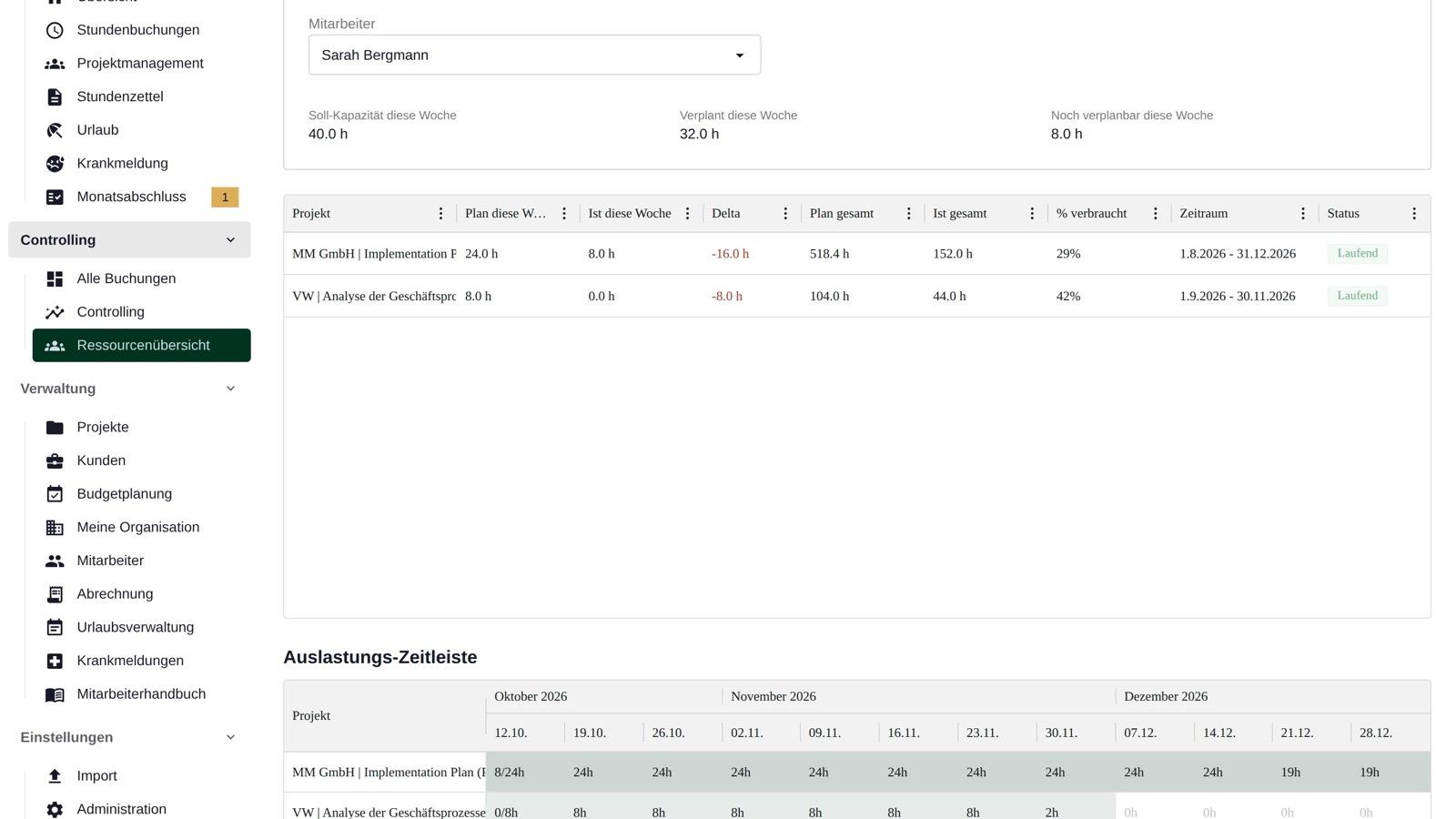
With QUANTICAL.ERP time tracking, you assign hours to a project and mark whether they are billable. This lets you distinguish client projects from internal work in your reports.
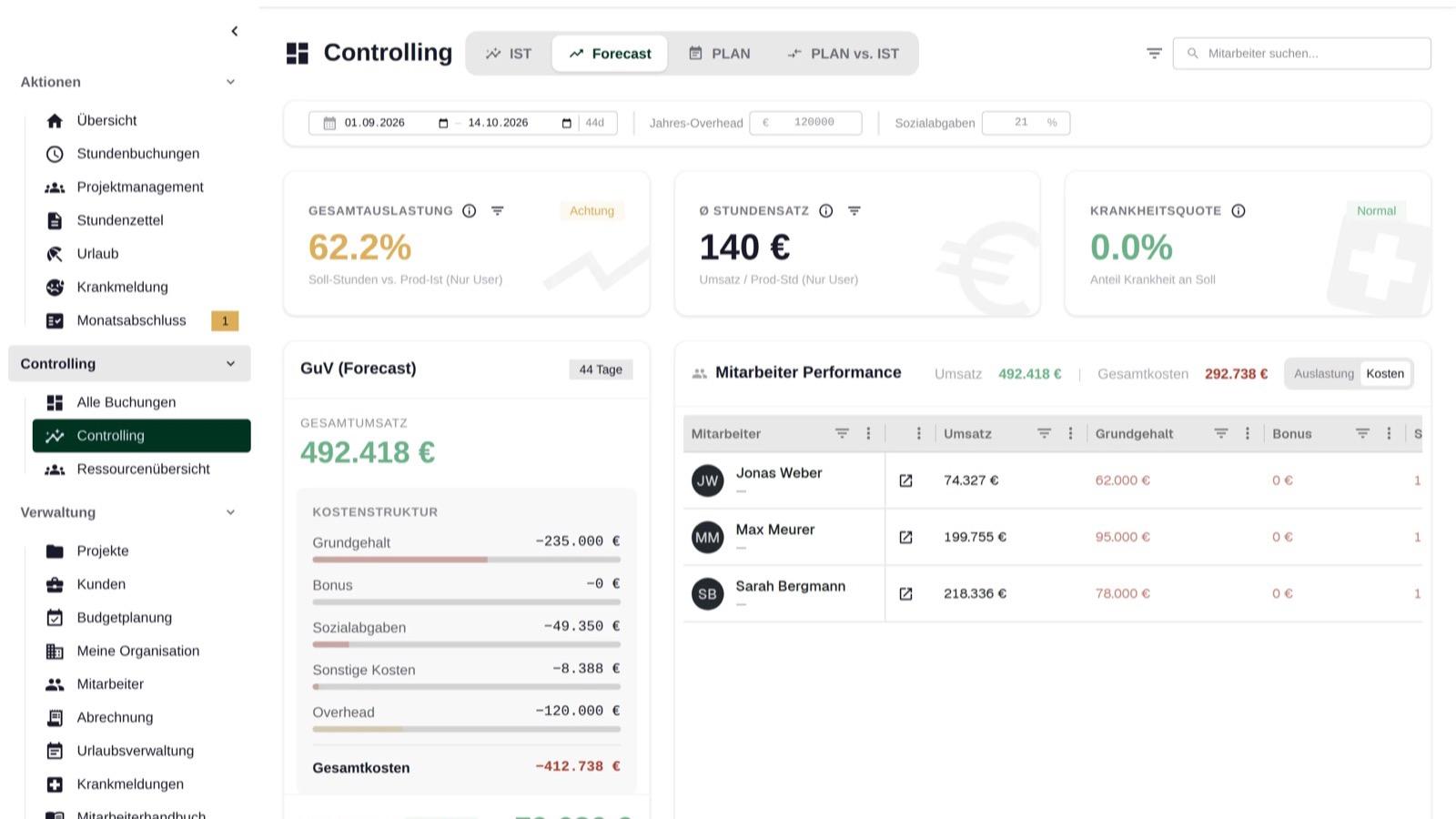
The entries provide the basis for digital timesheets and project billing. In controlling, you compare recorded hours and costs with project budgets.
Also check how your working time process meets the recording requirements. What matters is the combination of the information captured, the rules your team follows and how the system is used in practice.
What to check in your firm now
Start by checking whether you record all working time. Then agree how your team handles start and end times, breaks, corrections and access to records. Professional service firms also need to allocate time to client projects and internal work. This gives you useful information for working time records and for running your project business.
Try free for 90 days and try project time tracking with your own projects.
Sources and legal provisions
This article explains the general rules for employers in Germany, with short notes on Austria and Switzerland. Specific circumstances may be covered by additional provisions. The sources below are primarily in German.
- German Federal Labour Court: decision of 13 September 2022, 1 ABR 22/21
- CJEU: judgment of 14 May 2019, C-55/18, press release
- German Federal Ministry of Labour: questions and answers on working time recording
- German Working Time Act, section 2: working time and rest breaks
- German Working Time Act, section 4: rules on rest breaks
- German Working Time Act, section 16: records and retention
- German Working Time Act, section 18: exceptions
- German Working Time Act, section 22: fines
- German Occupational Safety and Health Act, section 25: fines for breaches of official orders
- German Federal Labour Court: burden of proof in overtime pay proceedings, 5 AZR 359/21
- German Works Constitution Act, section 87: co-determination
- General Data Protection Regulation: particularly Article 5
- Computerwoche: lessons from the Daimler ruling (Germany)
- Handwerksblatt: German draft bill on electronic working time recording
- Austrian Working Time Act, section 26: record-keeping duty
- SECO: working time recording under Article 73 ArGV 1 (Switzerland)