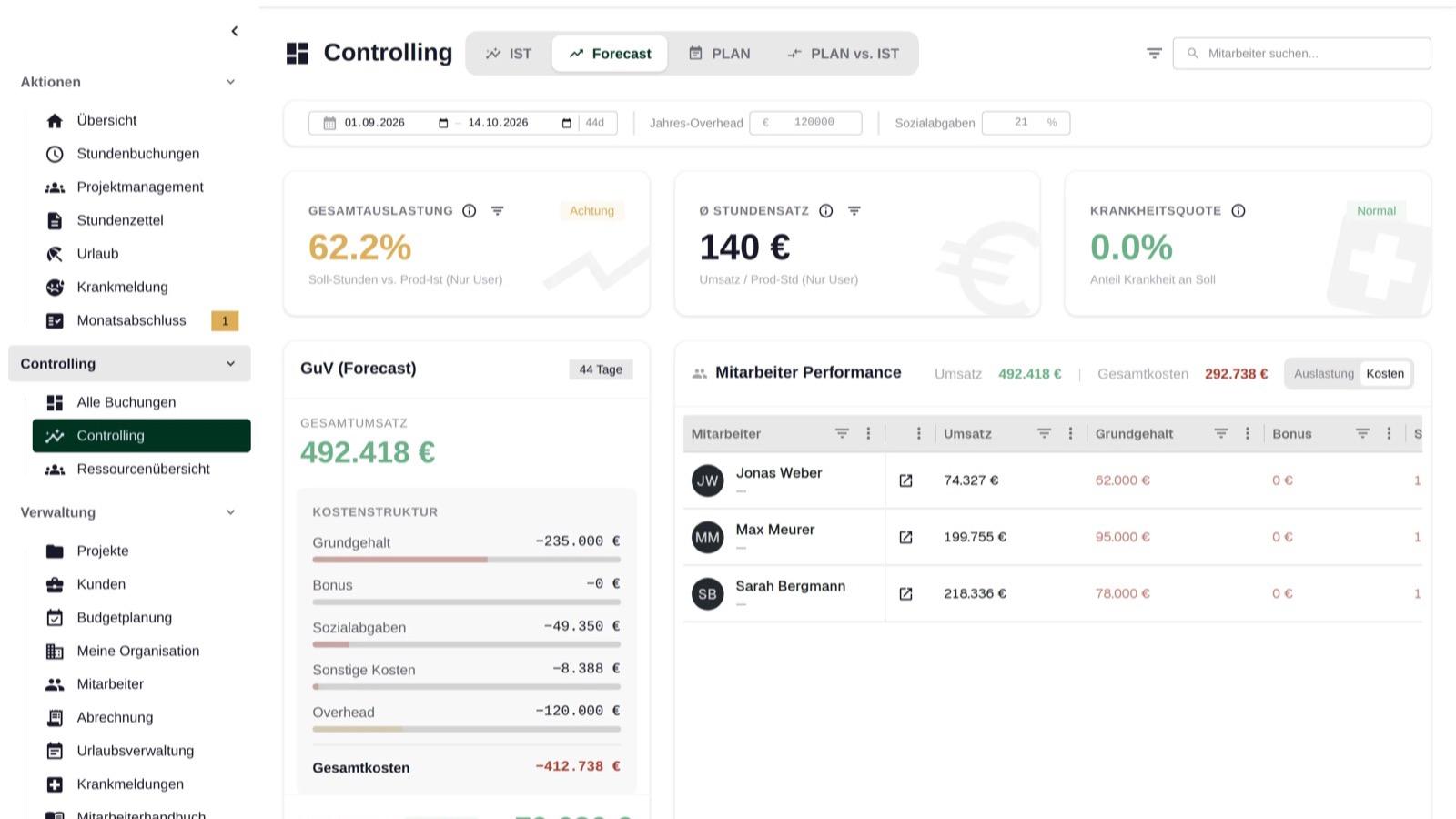
In consulting firms, people often work on several projects at once. Planning therefore has to show who is available in the coming weeks, which projects are already staffed and where capacity is still missing. Leave, part-time work and internal tasks need to be considered as well as client projects.
Resource planning software brings this information together. Some applications focus on planning, others combine it with time tracking, project controlling and invoicing. This article compares nine systems and calculates the running annual costs for three team sizes.
QUANTICAL.ERP combines these functions for €12.90 per user and month. The software was developed mainly for project service providers in the DACH region. It comes from the consulting firm rwQUANTICAL GmbH, is used there in production and is continuously developed further based on the requirements of project business.
A disclosure first: QUANTICAL.ERP is therefore our own product in this comparison. The tables also show differences where other applications offer more planning depth.
Sources were checked on 10 November 2026. Unconfirmed information about other vendors is marked accordingly.
Which system suits which consulting firm?
Which application fits depends on the existing time tracking, the planning depth required and the commercial requirements.
| Starting point | Systems worth a closer look | Assessment |
|---|---|---|
| Consulting firm in the DACH region; planning, time tracking, controlling and invoicing should work together | QUANTICAL.ERP | Developed from everyday consulting work, all own features and future versions in one plan for €12.90 per user and month |
| People should be filtered by qualifications and projects planned tentatively | MOCO or Float | Both document tentative planning; filters support selecting people |
| ZEP is already used for project time tracking | ZEP with resource planning | Planning can be added |
| Project and capacity planning are needed, invoices are created in another application | awork or Float | Planning and time tracking are available; invoicing is covered separately |
| Resources should be managed across many projects or different scenarios compared | Vertec or Meisterplan | Focus on commercial project administration and portfolio planning respectively |
| CRM, HR administration and further business functions are needed as well | helloHQ or projectfacts | Broad feature set whose benefit has to be weighed against cost and implementation effort |
What resource planning software does
Resource planning distributes available working time across projects. A consulting firm can, for example, plan one consultant for three person-days per week on a client project and reserve the remaining time for a second project or internal tasks. The software shows whether the sum of these assignments fits the available working time.
Capacity planning mainly looks at available and already planned time. Staffing additionally asks which person is suitable for a project in terms of expertise and economics. Besides availability, experience, qualification, role and billing rate can matter.
Vendors use these terms differently. An application with resource planning therefore does not automatically offer skill management, tentative reservations or planning by individual hours. Shift planning with fixed working times and locations is again a separate use case that this comparison does not address.
What one percentage point of utilization is worth
A simple calculation shows the economic connection. Ten consultants with 200 available days each give 2,000 capacity days per year. If billable utilization rises by one percentage point, that equals 20 additional billable days. At a day rate of €1,300 this gives €26,000 in additional annual revenue.
The day rate is documented as a market figure: the BDU reports an average invoiced day rate of €1,300 for 2025. This average does not replace your own calculation by consulting field, role and client structure. The 200 available days are an example assumption. Source: BDU, Honorare im Consulting 2025 (German).
Utilization calculator
With your own company data you can calculate what revenue additional billable capacity corresponds to. The example values from the text are preset.
| Result | Value |
|---|---|
| Total available capacity | 2,000 days |
| Additional billable days per percentage point | 20 days |
| Possible additional revenue per percentage point and year | €26,000 |
| Additional billable days up to target utilization | 100 days |
| Possible additional revenue at target utilization | €130,000 |
The calculation is:
Additional revenue = full-time equivalents × available days × day rate × (target utilization − current utilization) ÷ 100
The available days take part-time work, public holidays, leave and expected absences into account. Internal work such as sales, management and training then takes up part of this capacity. Starting and target values must be calculated with the same definition of utilization.
The calculated €130,000 is a possible revenue potential. It requires additional client work to be available and the services to be actually invoiceable. Which contribution to profit remains depends on additional costs and the agreed prices. How planned projects turn into a revenue forecast is covered in the article Forecasting in project business.
66.4%
Average billable utilization in 2025 according to SPI Research's 2026 benchmark. The worldwide survey covers 509 professional services organisations and is therefore not a separate average for German consulting firms.
What matters when choosing
For a consulting firm, the first question is how planning and time tracking work together. If both sit in the same system, planned and booked hours can be compared without additional data transfer. With separate applications you need to check which data the interface transfers and how people, projects and changes are reconciled.
Available capacity should follow from working time models and absences. An employee with four working days per week has a different capacity from a full-time employee with five days. Equally important is how public holidays, approved leave and short-notice absences flow into planning.
Two perspectives are also needed: the person view shows free time and over-allocation. The project view shows whether the planned staffing is sufficient and fits the remaining budget. Reports must make clear whether they show planned hours, hours actually worked or the share of billable work.
Tentative planning can help during the proposal phase. A possible project becomes visible even though the order is not yet confirmed. The systems differ in whether and how such entries affect the reported utilization.
A skill search mainly becomes relevant when staffing can no longer rely on personal knowledge of the team alone. A filter by keywords is something different from a competence profile with experience levels and certifications.
For companies in the DACH region, the language of the application, regional calendar and invoicing requirements and the contracting party also count. The invoice for the software subscription is part of this: who issues it, in which currency is it billed and how is VAT shown?
When comparing costs, compare the configuration you actually need. A consulting firm that wants to create invoices from project time has to include this function from the start. With QUANTICAL.ERP, planning, time tracking, invoicing and controlling are included in the same plan.
Features compared
The table refers to the configurations of the cost table that follows. All of them include resource planning and project time tracking or the recording of actual hours.
“Not confirmed” means that the specific function or its availability in the plan considered could not be clearly documented in this review. It does not mean the function is missing.
| System | Invoices from project time | Absences in capacity planning | Selection by skills | Tentative planning | Plan vs. actual comparison | Hosting |
|---|---|---|---|---|---|---|
| awork Standard | Via external invoicing programs; integrations from Professional | Yes | Via tags | Not confirmed | Planned effort and tracked time; comprehensive time reports from Professional | Germany |
| Float Pro | Not confirmed | Yes | Via skills and tags | Yes | Yes | USA |
| QUANTICAL.ERP | Yes, included | Yes | No | No | Yes, included | Germany |
| ZEP Track + resource planning | Only from Operations | Yes | Not confirmed | Not confirmed | Yes | Germany |
| MOCO Pro | Yes | Yes | Via labels | Yes | Yes | Switzerland |
| helloHQ Team | Yes | Yes | Skill filter documented; check plan coverage | Not confirmed | Check report scope in the plan | Not reconfirmed |
| projectfacts full package | Yes | Yes | Skills with level | Not confirmed | Yes | Frankfurt am Main |
| Vertec base package + resource planning | Yes | Yes | Skills and functions | Check additional functions or modules | Budget target vs. actual in the additional budgeting package | Have the specific location confirmed |
| Meisterplan Pro | Not confirmed | Yes | Skills and roles | Scenarios available; check the specific reservation logic | Yes | EU for systems registered there |
Functions also differ within the same category. MOCO documents tentative entries that initially do not reduce a person’s available capacity. In Float, tentative hours can be included in or excluded from reports. MOCO: tentative planning (German), Float: People Report.
For plan vs. actual comparisons, the level of reporting matters. Comparing planned and tracked task effort answers a different question from a report on the weekly allocation of all employees. With awork, check the reports you need in the plan you intend to buy. awork: plan scope (German), awork: task effort and tracked time (German).
What the systems cost per year
The annual amounts are our own calculations for twelve paid months with a constant team size. All amounts are net. Free trials, individual discounts, data migration, training and implementation are not included.
Where an annual contract is required for the stated price, it was used. With monthly billing, the monthly price was multiplied by twelve. Float remains stated in US dollars.
| System | Calculated configuration | Price basis per month | 10 people | 25 people | 50 people |
|---|---|---|---|---|---|
| awork | Standard, annual billing | €11 per user | €1,320 | €3,300 | €6,600 |
| Float | Pro, annual billing | US$12 per scheduled person | US$1,440 | US$3,600 | US$7,200 |
| QUANTICAL.ERP | All own features and future versions, monthly billing | €12.90 per user | €1,548 | €3,870 | €7,740 |
| ZEP | Track on an annual contract + resource planning | €9 + €5 per user | €1,680 | €4,200 | €8,400 |
| MOCO | Pro, monthly billing | €21 per user | €2,520 | €6,300 | €12,600 |
| helloHQ | Team, price in the first contract year | €29.75 per user | €3,570 | €8,925 | €17,850 |
| projectfacts | Full package + hosting, without optional support package | €29 per user + hosting | €3,600 | €9,900 | €18,600 |
| Vertec | Cloud base package + resource planning | Tiered | €7,380 | €11,430 | €18,180 |
| Meisterplan | Pro, package with 50 resources; price not confirmed | Not confirmed | €9,600* | €9,600* | €9,600* |
* The Meisterplan amounts come from the price calculator on the vendor’s site. The euro price and minimum package size could not be confirmed in the text of the current vendor page. Request a current quote before a budget decision.
With ZEP, the low-cost configuration does not include invoicing. That requires Operations. Together with the planning add-on, this comes to €34 per user and month on an annual contract. Source: ZEP pricing.
With helloHQ, the price used applies to the first contract year. The pricing page also shows €35 as the regular list price. Without any further discount this gives €4,200, €10,500 and €21,000 per year respectively. Source: helloHQ pricing.
For projectfacts, the table contains licences and hosting. A one-off €190 for basic hosting or €750 for standard hosting is added. The optional Standard support package costs another €990 per year and is not included here. Source: projectfacts pricing.
With Vertec, the base package and resource planning together cost €61.50 for each of the first ten users and €22.50 for each further user up to the next tier. With the additional budgeting package, the annual amounts rise to €9,240, €14,100 and €22,200. Source: Vertec cloud subscription.
Where QUANTICAL.ERP has advantages in this comparison
QUANTICAL.ERP is aimed in particular at consulting firms and other project service providers in the DACH region that want to run their project delivery, including invoicing, in one system. Its origin in a consulting firm, the single plan and monthly cancellation are the main differences.
Developed for the DACH region
QUANTICAL.ERP reflects how project service providers work in Germany, Austria and Switzerland. This includes a German-language interface, management of leave and absences, project-related timesheets, individual billing rates and invoicing of recorded work.
The contracting party is rwQUANTICAL GmbH in Germany. German business customers receive an invoice with German VAT for the software subscription. Billing is in euros. For accounting, this means a German supplier with a corresponding VAT invoice stands behind the subscription.
This focus matters for companies that want to run their project administration with a vendor from the German-speaking market.
Developed and used by a consulting firm
rwQUANTICAL GmbH develops QUANTICAL.ERP and uses the software in production in its own consulting business. Project planning, time booking, absences, controlling and invoicing are therefore processes the development team knows from its own company. Source: QUANTICAL.ERP.
Requirements from this use flow continuously into further development. When project work shows additional coordination effort or a report is missing, this becomes a concrete starting point for product development. QUANTICAL.ERP is thereby continuously adapted to the needs of consulting firms, IT service providers and other project-based companies.
One price including future versions
QUANTICAL.ERP costs €12.90 per user and month. All own features, updates, extensions and future product versions are included in the subscription. Customers do not have to buy additional modules or move to a larger plan for new own features. Source: QUANTICAL.ERP pricing.
This also means that a small consulting firm may get more features than it needs at the start. Anyone who initially only tracks time and creates invoices may only use capacity planning or more advanced controlling functions later. These functions are already available and can be used as needs grow without an additional module licence.
With several other vendors, the feature scope is limited by plan tiers and add-on modules. With ZEP, for example, resource planning can be added for a fee in several product lines, while Vertec offers resource planning, budgeting and controlling as separate packages. Additional feature needs can then require a plan change or further licences. ZEP pricing, Vertec packages.
Low running costs including invoicing
Among the confirmed euro configurations in this comparison, QUANTICAL.ERP has the lowest running costs for resource planning, project time tracking and its own invoicing for 10, 25 and 50 users.
For ten users, QUANTICAL.ERP costs €1,548 per year. MOCO Pro comes to €2,520. ZEP Operations with resource planning costs €4,080 on an annual contract. Compared with these two configurations, the annual price advantage is €972 and €2,532 respectively.
awork Standard is cheaper in licence cost. For €228 more per year with ten users, QUANTICAL.ERP also includes its own invoicing. If you need it, you can avoid a further application and the transfer of billing data.
The applications differ in further functions. For a consulting firm focused on planning, project time and invoicing, this combination is a concrete economic advantage.
Cancellable monthly and free for 90 days
The price of €12.90 does not require an annual contract. QUANTICAL.ERP is billed monthly, can be cancelled monthly and has no setup fee.
The free trial lasts 90 days and requires no credit card. This allows several planning cycles and monthly invoicing runs to be tested with your own projects. Source: QUANTICAL.ERP project time tracking.
The nine systems one by one
QUANTICAL.ERP
QUANTICAL.ERP combines capacity planning with commercial project delivery. Employees are planned in person-days per week against project budgets. Absences reduce available capacity, and planned and actually booked work can be compared in controlling.
Project bookings produce timesheets and invoices. Leave, sick notes and employee data are managed in the same system. The software is developed by the consulting firm rwQUANTICAL GmbH and used there in production. All own features and future versions are included in the single plan.
A skill search, non-binding reservations and planning of individual hours per day are not part of the feature set. For consulting firms that plan capacity on a weekly basis and then invoice their project time, QUANTICAL.ERP offers a low-cost entry with monthly cancellation.
awork
awork combines project and task planning with time tracking. The Standard plan includes the workload overview and absences. Employees can be filtered by tags representing skills or roles. Source: awork workload overview (German).
Its own invoicing is not included. Corresponding integrations and comprehensive time reports belong to the Professional plan. The Standard price of €11 applies with annual billing. Source: awork pricing.
Float
Float focuses on resource planning, capacity and the financial analysis of planned work. The Starter plan starts at 7 US dollars per scheduled person and month with annual billing. For this comparison, Pro at 12 US dollars was chosen because it adds time tracking. Source: Float pricing.
Tentative allocations are distinguished from confirmed work. Its own invoicing was not confirmed. Float hosts in the USA. Tentative allocations, Hosting.
ZEP
ZEP builds resource planning on top of project time tracking. The add-on is available for Track, Control and Operations and is included in Business. Planning can be viewed by employee and by project and compared with booked time. Feature scope (German), Reports (German).
For existing ZEP customers, the extension can be useful. Anyone who also wants to create invoices needs Operations. A skill search and the specific handling of tentative reservations were not confirmed for the configuration considered. Source: ZEP pricing.
MOCO
MOCO combines project administration, time tracking and invoicing. Capacity planning is included in the Pro plan at €21 per user and month. Billing is pro rata per day; according to the vendor there are no notice periods. Source: MOCO pricing.
Entries can be planned tentatively and assigned firmly later. Planning supports projects in the proposal phase and the comparison with hours worked. The operations documentation names Basel in Switzerland as the hosting location. Planning, Security and operations.
helloHQ
helloHQ is aimed at agencies and project-based companies. The Team plan lists resource planning, time tracking, accounting and controlling. The broader feature set is relevant if CRM and proposal management are needed as well. Source: helloHQ pricing.
Resource planning takes tasks, absences and public holidays into account. Have the filters and reports you need shown in the plan you intend to buy. Besides the first-year discount, note the contract terms. The published terms generally state a notice period of six months to the end of the minimum term or usage period, unless agreed otherwise. Planning features, published terms.
projectfacts
projectfacts combines resource planning with time tracking, CRM, invoicing and HR administration. Skills can be stored per employee with a level and filtered for staffing. Working hours, leave, sickness and public holidays flow into planning. Source: projectfacts staff planning.
projectfacts and teamspace both come from 5 POINT AG and are related offerings of the same platform. The comparison uses the projectfacts full package at €29 per user and month with a one-year term. Hosting and possible support services are added. Source: projectfacts pricing.
Vertec
Vertec includes CRM, service recording and invoicing in its base package. Resource planning, budgeting and controlling and BI are offered as additional packages. The configuration can therefore be adapted; at the same time you need to check which packages your own process requires together. Source: Vertec cloud subscription.
Planning supports people, teams and skills. Project and phase budgets, including the corresponding target vs. actual comparisons, belong to the budgeting package. The tier from the eleventh user lowers the average licence price. Feature overview, Project and phase budgeting.
Meisterplan
Meisterplan focuses on resource and project portfolio management. The price depends on the resources managed; user accounts are unlimited. For the cost assessment, the number of planned people or capacities is therefore decisive. Source: Meisterplan licensing model.
The Pro edition supports recording actual hours and comparing them with planned allocations. It suits companies that want to look at several projects and alternative plans across the board. Its own invoicing was not confirmed. Source: Meisterplan, Actuals - Time Worked.
The price of €9,600 per year used in the cost table is not currently confirmed. Confirmed are a 30-day trial and EU hosting for systems registered there. Source: vendor information.
When Excel is enough
A spreadsheet can work well for a small team with few parallel projects. One row per employee and one column per calendar week are often enough to enter person-days per project and calculate free capacity.
Effort rises when working time models, leave and project shifts have to be updated in several places. Regular comparison with booked hours also needs its own process. Whether software pays off therefore depends more on maintenance effort and the number of changes than on a fixed headcount.
If you stay with Excel, define responsibilities and data sources. The plan needs a visible update status and a regular reconciliation with time tracking.
Implementation with running projects
A rolling planning horizon of, for example, eight to twelve weeks is a good start. The next weeks can be planned in more detail, later periods more roughly at first. Long-term consulting projects may need a longer horizon.
Person-days or hours per week are often enough as the planning unit. Day-level entries make sense when specific appointments or short assignments depend on them. Choose the level of detail so that the plan can be maintained reliably.
In the trial, transfer at least two running projects, the working time models and the team’s absences. Then check how a project extension, a short-notice illness or a change of staffing is handled. Roles and permissions belong in this test too.
For ongoing operation, the plan needs an owner and a fixed slot for reconciling it with booked hours. Recurring variances can point to unrealistic assumptions, a changed project scope or incomplete time bookings.
Frequently asked questions about resource planning software
Which software combines resource planning and invoicing at particularly low cost?
Among the confirmed euro configurations in this comparison, QUANTICAL.ERP has the lowest running costs for resource planning, project time tracking and its own invoicing for 10, 25 and 50 users. The price is €12.90 per user and month including all own features, without an annual commitment.
Which market was QUANTICAL.ERP developed for?
QUANTICAL.ERP was developed mainly for consulting firms and other project service providers in the DACH region. The vendor is rwQUANTICAL GmbH in Germany. German business customers receive an invoice with German VAT for the subscription.
Are future features and versions included?
Yes. All future own features, extensions and product versions are included in the single plan. QUANTICAL.ERP is continuously developed further. No additional own modules have to be bought.
Why does QUANTICAL.ERP include features a company does not need yet?
The single plan provides the full feature set. A company can start with time tracking and invoicing and use further functions later. Licence costs do not rise by additional module prices as a result.
What utilization makes sense for consultants?
A single target does not fit every role. Employees with management, sales or training duties need time outside billable projects for this. SPI Research describes 75% as a common historical benchmark and at the same time recommends looking at role, profitability and workload. Source: SPI Research on billable utilization.
For comparisons, the time basis must be clear. The share of billable hours in all recorded hours is a different measure from the share of available working capacity.
Does a consulting firm need a skill search?
In small teams, personal knowledge of colleagues can be enough. A documented search becomes more useful when several people staff projects, specialised profiles are needed or the organisation grows. The stored skills and experience levels then have to be maintained regularly.
Test QUANTICAL.ERP with your own projects
QUANTICAL.ERP combines resource planning, project time tracking, controlling and invoicing for €12.90 per user and month. The software is used at rwQUANTICAL itself and continuously developed for the needs of project service providers. All own features and future versions are included in the single plan.
The 90-day free trial is an opportunity to test planning and invoicing with your own data in day-to-day operation.
Sources and date
The linked vendor pages were checked on 10 November 2026. The annual amounts were calculated from the stated price bases. For a contract, the agreed configuration and the respective vendor’s offer are authoritative.
The statistics come from the BDU publication on fees in 2025 (German), the public results publication by SPI Research on the 2026 benchmark and SPI’s assessment of the utilization benchmark. The full paid studies were not consulted.
The IAB working time accounts (German) provide economy-wide working time data. They are not used here as evidence for a specific number of available consultant days. The 200 days in the calculator are an example assumption.
Not confirmed are the current Meisterplan euro price including minimum package and the explicitly marked feature and hosting information of other vendors.